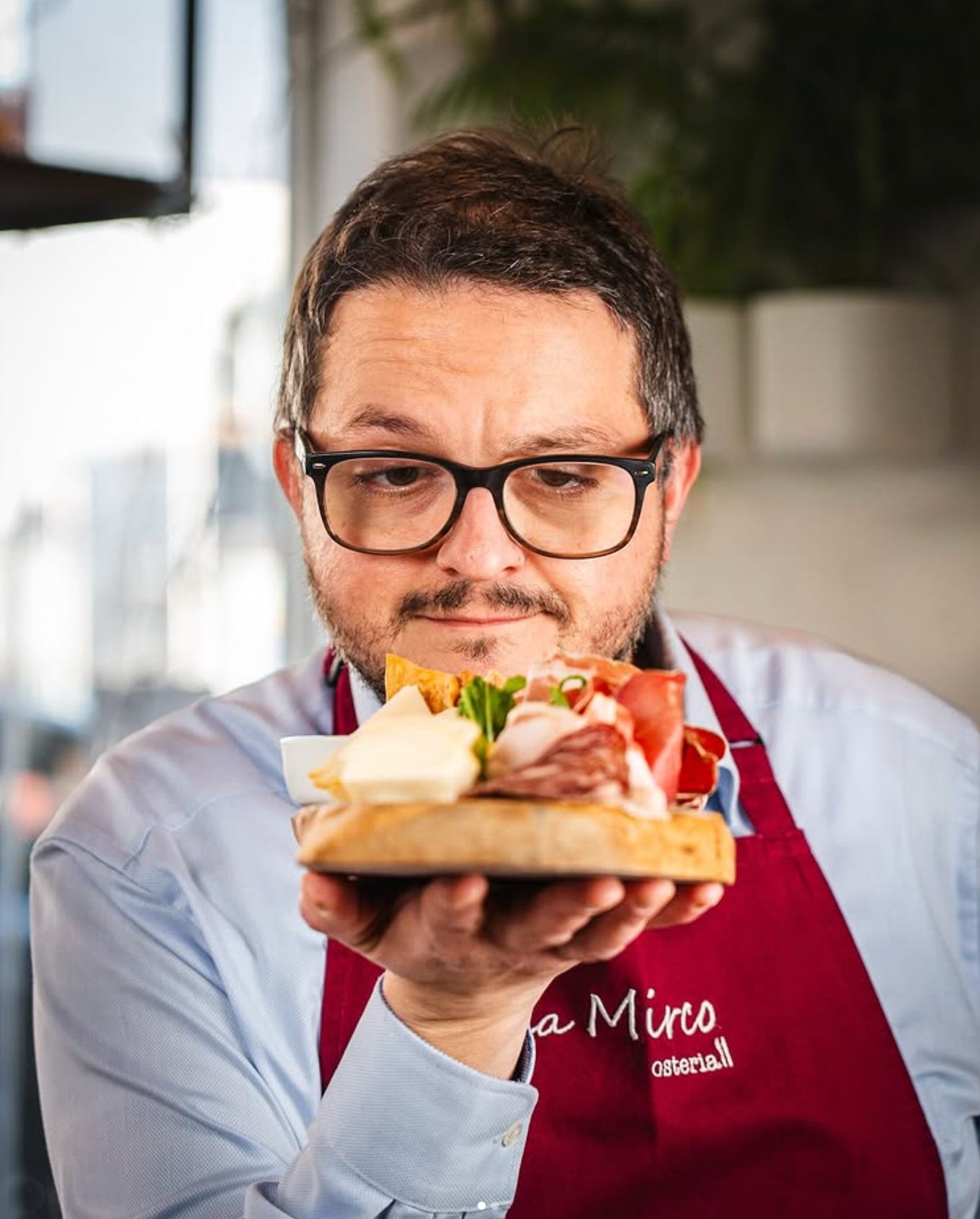
The Festive Grazing Board
Expert advice from Mirco Fondrini of Cork's Da Mirco Osteria.

Could there be anything more festive, more celebratory, more supremely social than an abundant grazing platter? Whatever country or region it hails from, or by whatever name you call it – smorgasbord, kamaya, pu pu platter – the grazing board invites one and all to get the party started.
For millennia people have socialised with a ritual feast of sharing, grazing and, of course, drinking. Making a grand platter to share combines the essence of both hospitality and generosity. But, how do you make it special?
We asked Mirco Fondrini to tell us about the Tagliere he serves in his Cork restaurant, Da Mirco Osteria.
First up, an explanation. Tagliere is an antipasti where three of four cuts of cheeses, and cured meats are offered with pickles, jam, honey or nuts. The tagliere begins the meal, and is followed by a risotto or pasta dish, and then the meat and vegetables course. Many Trattoria in Italy offer a no choice menu, and use only Italian cured meats and cheese.
The word Tagliere is literally just the name of the wooden board on which the food is arranged. The foods presented on the board are primary ingredients – cheese, charcuterie, pickles, bread – we’re not talking canapés here. Simple raw ingredients, and their sourcing is of pivotal importance to making it special.
Types of cured meat are prosciutto crudo (cured) or cotto (cooked); bresaola (air-dried beef); lardo (seasoned fat, the Tuscan version famously cured in marble); speck. These foods are now DOP protected and the Slow Food Movement has done an enormous amount of work to honour and preserve them.
What makes Tagliere Da Mirco so delizioso?
“I come from a family that was making cheese. We used to kill the pig. We cured meat, made prosciutto, salumi. The meat for our Tagliere was sliced by hand. If someone came to the house they were offered a glass of wine (not a cup of tea), some bread, cheese, all cut by hand. It was rough, peasant food. That’s how I was brought up”.
Fondrini comes from Morbegno, which is north of Lake Como and near the Swiss border in the low Valtellina valley. Valtellina produces the air cured beef, bresaola as well as salame (with a mix of pork and beef) lardo and coppa. It’s also known for speck (which everyone thinks is German, but it’s Italian)
The northern region of Lombardy is also home to some very special cheeses. “The area has a lot of alpine cows but we don’t use them for slaughtering, just for cheese and butter” Mirco explains. For his restaurant in Cork, Mirco imports all the local cured meats from a Valtellina butcher and deli shop owner, Frederico Zecca, and from the same source he imports Gorgonzola, Taleggio, and Capra cheeses.
Da Mirco Osteria also serves the rare storico ribelle – a traditional cheese made by a cooperative in Gerola Alta, who refused to deviate from the traditional method, which is made from a mix of cow’s and goat’s milk, and aged for a very long time. Ribelle translates as “Rebel” and the synergy of selling it in Cork, the Rebel County, is not lost on Mirco.
Mirco’s Tips for Creating your own Tagliere
Choose three cheeses each with a different consistency. Maybe a West Cork soft rind, a Blue, possibly a hard blue like Boyne Valley, perhaps a cheddar style, perhaps Coolea, or maybe a fresh cheese.
Add three different cuts of cured meat, usually pork, but sometimes beef: cured sausage, prosciutto, speck, coppa, bresaola.
Mirco serves home-pickled garden greens, which he calls giardiniera. He also makes a quick crunchy pickle of carrots, celery, cauliflower, peppers or onions.
Where Mirco serves a tomato jam, you could add a chutney, or some honey. You can also add olives, sundried tomatoes, artichokes in oil. Nuts are good, but toast them first. Cheese is great with pickles like cornichons, which go just as well with cured pork.
Bread could be focaccia, or a crusty bread. Look for a bit of a crunch. You could also serve crackers, or grissini.
The arrangement
Slice the cheeses and the meat. Place the pickles and condiments in small bowls. Mirco starts with a bowl of tomato jam in the middle and arranges each different food around it like a clock face.
How to Eat
There are rules. This is Italy, of course there are food rules.
First up: DON’T USE A KNIFE AND FORK! This is finger food. Don’t mix the meat and the cheese. You can eat the cheese with a cracker, Parma-type ham is great rolled around a bread stick.
Don’t put fruit on a starter plate! Fruit, like grapes for example, is for the late cheese course, not the antipasti.
Take everything out of the fridge about an hour before you serve, depending on the temperature of your house.
Mirco’s Christmas Dinner
Christmas dinner di Mirco does indeed begin with tagliere. The wine paired with tagliere is often a red wine “a juicy red wine, not too sharp, maybe a Barbera from Piedmont” says Mirco. But the platter also pairs well with a sparkling dry wine – “not champagne, and something dryer than prosecco, maybe a Brut or a Cava”.
For Christmas, Mirco adds some cured fish to the platter, recommending sword fish, or tuna. This year he’ll probably make vitello tonnato.
Next the pasta, often a baked pasta, like lasagne or cannelloni. This year he’s going to make ravioli with a filling of duck ragout, and serve it in a butter and sage sauce.
Now the main. Roast beef, or meat loaf (“my kids love meat loaf, made from pork or lamb”). This is served with roast potatoes and veg.
Finally some fruit or a panettone.
We started at 12.30pm and “it’s already 6pm” he adds.
“It’s now I bring out the cheese. I know I’m completely stuffed, but I always want some cheese.” This final cheese course is “always a French cheese, maybe a Bleu d’Auvergne. We drink a dessert wine with it.”
Happy Christmas Mirco! We’ll do our best to live up to your beautiful advice.
Important Public Service Announcement
Do not listen to any cook or writer who insists that turkey cooks after 15 mins per pound weight, plus 15 mins. This is outdated info that hangs around at Christmas like a zombie, refusing to die. It’s not about time, it’s about temperature. More details here.


